🎲 Game rules
Dice, portals, the toilet and the rest. A five-minute read.
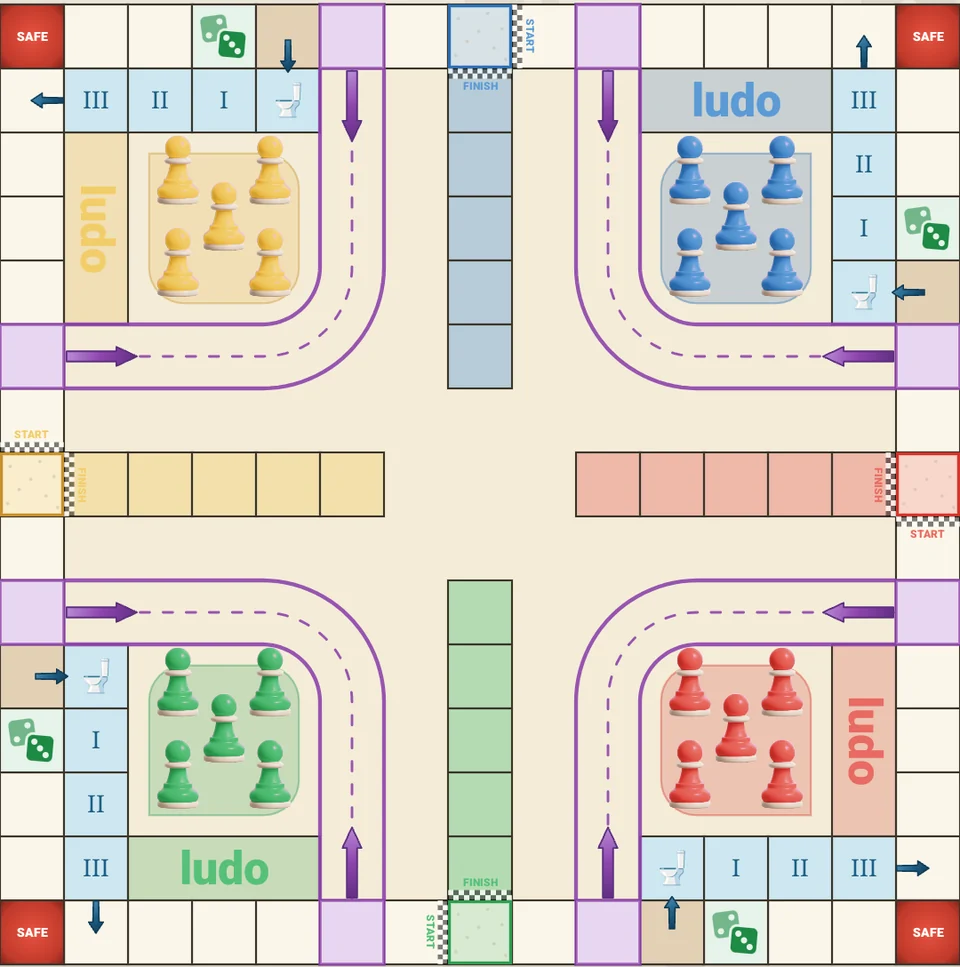
The goal
Each player has five pieces. Get all five around the board and into your home before your rivals do.
Rolling the dice
Every turn you roll two dice. You can play both values with one piece or with two, but you always move the higher value first. If the first value has no legal move, it burns. If the second has none either, the turn passes to the next player.
You can’t jump over an occupied cell: any piece blocks the path, yours or a rival’s. Pieces enter the home only by exact count and can’t go past its last cell.
A six brings a piece out of the base onto the start. Without a six, no new pieces enter the game.
Doubles
Both dice show the same value: move, then roll again. A third double in a row burns: you can’t move with it, and the turn passes to the next player.
Capturing
Land on a rival’s piece and it goes back to its base, and you roll again. No apologies needed. Coming out onto the start captures too: if a rival’s piece stands there, your six sends it back to base.
SAFE cells
A piece on a SAFE cell can’t be captured. Only one piece fits there: while the cell is taken, no other piece can step on it, yours or a rival’s. A good place to wait things out.
One cell, one piece
Two of your own pieces never share a cell, on the ring or in the home. The toilet cubicles are the only exception. This applies to the start too: until the piece you brought out moves away, you can’t bring out the next one.
The toilet
Step on the toilet cell and your piece gets pulled inside. The only way out is in order: a 1 moves it to cubicle I, a 2 to cubicle II, a 3 to cubicle III. From cubicle III any value gets you out: a 1 puts the piece on the exit cell, a higher value takes it further around the ring. The whole path of suffering is drawn on the board.
Pieces in the cubicles can’t be captured. Captures happen only at the entrance: if a rival’s piece is still waiting there for a 1, your piece falling into the same toilet sends it back to base.
A lone piece gets a break. If it’s your only piece on the board and the rest are home or in the base, it falls into the same toilet no more than twice. The third time it just stands on the cell. The count starts over if the piece is captured or you bring out a new one.
Portals
A road cell instantly carries your piece across the corner of the board to its paired cell. From one end the road is a shortcut, from the other it throws you back, so watch where you step. A rival’s piece at the far end goes back to base. If your own piece is there, you don’t travel.
Extra roll
The cell with dice gives you one more roll if your piece ends its move there. You never get more than one extra roll per turn: a double, a capture and this cell don’t add up.
Winning and tokens
The first to bring all five pieces home wins, and the game ends. The other places go by how many pieces each player has home, and that affects rating. So bring home as many as you can.
Every game costs one token. A ranked win pays tokens: 2 at a table of four, 1 at a table of three, none in a duel. You get 10 tokens when you sign up, and if you have fewer than 5, your balance is topped up to 5 for free once a day. Tokens can’t be bought or exchanged for money.
Modes and playing with friends
Arena is a ranked table for 3–4 players, and leagues follow its rating. Duel is a one-on-one game with a rating of its own. In both modes the system finds your opponents.
To play with friends, tap “Play with friends by code”, create a table and send your friends the 6-character code. Start the game once everyone has joined. These games are unranked, like a practice game against the computer.
Opponents online
Matchmaking seats players with similar ratings. If there aren’t enough suitable live players, at night for example, game bots take the empty seats so the game starts without a long wait. Bots play by the same rules with the same dice, and the game counts towards your rating like any other.
Turn timer
Online, you have 30 seconds per turn. Don’t roll in time and you lose the turn. Roll but don’t move, and the system plays for you, not in your favour. Miss three turns in a row or leave the game and you’re out; in a duel that’s an instant loss.
Achievements
Your achievements are listed in your account. The more you collect, the thicker the laurel wreath around your avatar, and everyone at the table sees it.
Rating and leagues
Wins raise your rating and your place on the worldwide leaderboard. There are seven leagues, and your league badge shows in your profile and at the table. Leagues follow your Arena rating; Duel has its own rating without leagues.